Concision is overrated. Repetition is the new concision.
Concision is overrated. Repetition is the new concision.



The cage is closed but monkey bars are open*
11 months ago
Concision is overrated. Repetition is the new concision.
Concision is overrated. Repetition is the new concision.
Okay, I am preparing myself for a veritable FLOOD of comments, not to mention people with pitchforks and torches outside of my door. Damn! I think they’re here. Read fast!
In the recent blog entry I’d posted about congestion pricing, I did something out of literati-wanna-be character for myself. I panned a plan without offering an alternative solution. I did so to stay on topic, of course, but also because I’d already skull-numbed Chappy and Bullet with two epic posts in a week. I’m sure the slight misuse of the oh so common words “autocentric” and “nary” didn’t help with flow. This blog entry will, in fact, offer one alternative solution to raising revenue in NYC whilst curtailing traffic and gridlock in Manhattan proper, if not the city at large. But, the content of this suggestion will doubtlessly ruffle enough feathers that there’ll be a virtual dirt nap in my blogging future. Here Lies Pockets, Rest In Pants.
A great number of cities and townships in the states now boast everyone’s favorite traffic control device, the red light camera, otherwise known as the Ticket Camera or #@!$%^&^%!! If you are unfamiliar, count your blessings and your money. This is a camera or set of cameras automatically snapping photos at an intersection with the express purpose of ticketing driver’s who violate red traffic signals. Photos are snapped, the license plate is captured in the image, and a high-priced summons arrives in the registrant driver’s mail along with a photo of her/his alleged infraction some time after. Gotcha! “But that was a harmless night of chicken plucking, birch beer, and the Wu Tang Clan. I can’t believe those bastards did this to me!”
Absent from common knowledge was the manner in which age-old laws and rules of law enforcement in many states had to radically change to allow for the devices. To use one east coast county as our looking glass, it had always been procedure that reports of crimes and violations could reach a sector car in one of three ways. A call could come in via police radio. A bystander could run up to the car and point officers in the direction of a crime taking place or a person in need. The cops could react to witnessing a crime themselves while on patrol, pretty much necessary for lesser moving violations. This permissible three-fer procedure helped to prevent corruption. Limiting the initiating sources made it difficult to manufacture false evidence convincingly. Requiring that written reports begin factually with one of only three starting points made it far more difficult to take random or rogue action. For the same token, the three-pronged procedure also quelled the bearing of false witness by citizens. A person would have a more difficult time pinning a false crime report on the neighbor kid who porked his daughter if the process had to begin by talking to the police. A person couldn’t run up with a trick photo of a banker boffing a zebra in the playground without the promise of cops investigating. In all three cases, however, it was expected of cops to be PRESENT to bear out the proper response action. They had to go to where the infraction was taking place. They had to get on-scene. In fact, an officer’s written report or summons, the sole official document of each such event, was so predicated upon the importance of an authority figure’s first hand knowledge of an incident, that almost any contradictory claim was readily dismissed and lack of proper police report could make or break one’s argument in court.
Well, the red light camera has no such police presence. While the photo itself still goes through law enforcement personnel before ever reaching an accused’s mailbox, the photo is no longer first-hand knowledge, but barley second-hand knowledge. In fact, given the boundaries of a photograph, it is a limited second hand knowledge at that. It’s like a slutty reputation in high school or a belief that Dr. Pepper contains prune juice. Sure, all knowledge is limited, but clearly the minor point here is that a photograph will always be more limited than the knowledge of an officer on-scene. In some cases, under older law, some red light camera photos would prove little different than hearsay. Seesaw?
Thus, in many states, this required direct change to major legislation. For some other states and counties it meant simple additions to laws. For still others it meant finding adjudicative justifications within existing bodies of law when legislation was slow to change. Some places simply shifted the onus of clear determination from the law enforcement level to an already backlogged judicial level, people showing up to fight all sorts of red light camera photos only to predominantly lose in the end. “Yes, I did run the red light, but as you can see in the photo, my penis was caught in the vent window!” What’s more, legislation change was not the limit to problems with red light camera philosophy. For instance, unlike a parking ticket where a vehicle is still, is it not counter-intuitive to presume true witness to a MOVING VIOLATION in a STILL photograph? The legal shift, middlingly justified by a government attempt to make roads safer, is certainly one in favor of big brother, big government, big revenue, and tech’ solutions over human ones.
It is because of these inherent fallacies in red light camera programs, that while acknowledging noticeable decreases in traffic accidents at equipped intersections, I have to disagree on a fundamental level with their application.
Don’t hoist me as the hero just yet. You are about to hate the playa.
What if, just what if, despite my distaste for red light camera programs, I asserted a newer, wider application of these changes in law? No, not stoning. Well…
My chief argument against congestion pricing in the post noted earlier was that it punishes the people already doing the correct thing, an unjust act of wrongfulness no matter how one explains its “need.” If I purport my assertion to be a blockbusting bill-killer in all future congestion pricing proposals, then I need to acknowledge my claim’s inverse. I need to support ideas which only punish wrongdoers and spare already error-free commuters any hassle. I have such an idea. I like it. I call it the Civilian Ticket Patrol. Bum--ba-duh-dump.
If our legislation has already been eased to allow "police absence / tech’ presence" style evidence in the form of still pictures, then it is not that far of a leap to do something similar with motion pictures. Video cameras can easily capture far more moving violation types than a still camera. Illegal u-turns, blown stop-signs, failures to yield, failures to signal, equipment violations, one-way street violations, illegal turns, fender-benders, these can all be SEEN on video. Video devices mounted in the grills and on the dashboards of police vehicles already do this during routine traffic stops. One merely needs to check out The World’s Scariest Police Chases or Cops to see how many precincts and sheriff’s offices use this tool to great evidentiary achievement. Well, instead of "police absence / tech’ presence," why not "police absence / citizen-tech’ presence?"
I reluctantly propose that we implement a system whereby city citizens with registered, insured, personal vehicles can choose to have their vehicles outfitted with similar motion picture capture devices at no charge. The system would need to be a closed system that disallows tampering. A driver’s only interface with the system would be a keypad that marks a starting and ending video time index to bracket a moving violation they’ve just witnessed, and perhaps a wireless upload switch to the police department or an ejectable, lockbox media to mail-in to the police. The device would need to be well hidden for citizen safety. The interface component would only work when the Citizen Patroller had her/his own vehicle parked, again with regard to safety. Video would be automatically time and date stamped and uniquely coded with the video capture unit number. Ejectable lockbox media would not be accepted at the police department if it showed any signs of breakage or tampering. I would suggest a wide angle lens set with a focal point broad enough to pick up street signs and oncoming cars. I'd also suggest a GPS feature to further add to the information gathered.
On the front end, citizen selection for the program would be key. Interested parties would be put on a waiting list. Nobody with outstanding parking or moving violations, criminal records or warrants would be eligible. No one without a current driver’s license would be eligible. Nobody with pending court cases would be eligible. Nobody with orders of protection or orders of protection against them or other legal documentation implying potential grudges would be eligible. No hunchbacks. Etcetera, etcetera, etcetera.
Participant citizens would receive training on the interface, training on what constitutes a moving violation, training on recognizing non-viable video capture (both technologically and with regard to the law), and training on safe use of the tool (CTP procedure). Citizen’s would NOT be pulling cars over or issuing tickets themselves. Citizen’s would NOT be patrolling, but merely capturing moving violations in their day-to-day doings around the neighborhood. Jeez, Louise, I “happen” across 10 creative moving violations a day just going from my apartment to the babysitter’s place. Good evidence, chained properly and resulting in adjudication against a violator would yield a percentage of the revenue collected on the ticket back to the video capturing citizen’s pocket. Money! Money taken from the “bad people” and given to the “good people.” Holy cow, I’m Robin Hood!
On the back end, more cops/legal officials would need to take more time to witness the video captured evidences. (Video takes longer to see than a photo.) These officials would be the sole deciders as to whether a ticket is warranted and issued on the video or not, just like red light camera photos, retaining the proper decisive authority where it belongs. Time and date stamps would determine the immediacy with which a video was received. Cops should be given the authority to simply throw away any video evidence that arrives long after the date stamp (preventing people from saving up incriminating evidence). Cops should be given a workable CTP database for cross-checking and the authority to discard any video evidence received from the same patroller on the same vehicle more than once, to prevent stalking, blackmail, entrapment, and varied forms of citizen corruption.
There would need to be oversight provisos aplenty. Any willful violation of CTP procedure and policy would result in immediate shutdown and removal of the apparatus from the citizen's personal vehicle at the owner’s expense, even getting towed to do so, if not her/his own arrest. Further, CTP procedure violators should be fined at least ALL monies collected through their actions on previous captures. Such violations should include but not be limited to
1) Speaking to the violator caught on video
2) Sending in more than one (or pick a reasonable number) video violations on the same vehicle
3) Any indication of device, data, or media tampering
4) The interruption of any police officer in the course of her/his duties
5) Evidence of entrapment.
6) Breaking motor vehicle law in order to capture some one else breaking motor vehicle law
7) Posing as a police officer
8) Expired driver’s license
9) Expired vehicle insurance
10) Expired vehicle registration
11) Failure to pay one’s own tickets
12) Video capture of the patroller’s own vehicle in a moving violation
13) Equipment used to spy.
For years police departments have talked about citizen’s being the eyes and the ears of their neighborhoods. They express actual regret in not being able to protect everyplace at once. They beg neighborhood watches to be on the lookout, commuters to keep eyes open for suspicious behaviors and objects, victims to report crimes against them, and building/business owners to install security cameras. The Civilian Ticket Patrol is an extension of that very want. While it utilizes an existing segment of law that I find somewhat deplorable, there are a great deal of long sought after complications that a program like this might well resolve.
Let’s examine.
The practice only punishes those who are breaking the law, as opposed to blanketing the entire area with new rules and fees that target innocents and traffic violators equally.
It spreads the eyes and ears of otherwise official units charged with preventing traffic violations out among as large and invisible a cross–segment of the city population as any city is willing to fund.
Unlike red light cameras which groups frequently document and post online to create a map of avoidable intersections, these cameras are mobile; they can be at any place at any time, a truly more effective deterrent to traffic violation than a stationary, visible camera.
This can easily put a little extra money in ordinary people’s pockets without the lengthy governmental red tape of raising minimum wage, encouraging new local business, or creating jobs. Once up and running it is quite an immediate return for both city and citizens.
As stated before, a video system would capture far more types of infraction than a single, red light camera can.
Former New York City Mayor Giuliani, and to a certain extent, the now NYC Mayor Bloomberg have frequently asserted that the best action to curtail gridlock/traffic in Manhattan’s central business district would simply be for those on the road to follow the existing rules. New York City has signs at so many of it’s major intersections warning “Don’t Block the Box,” meaning, do not enter an intersection, even on a green light, if you cannot safely cross the entire intersection to the opposite side. A large number of these intersections have even painted a giant cross-hatching right onto the pavement so that drivers can see the “box” in question. Heck, many of the red light cameras in Manhattan were mounted for this express purpose. Much to the city’s surprise after implementing them, a great number of the red light scoffing culprits were their own city bus drivers. The point being, if officials insist that moving violations (not traffic volumes) are a direct cause of city gridlock, to the tune of implementing multi-million dollar systems targeted to decrease just one type of said violations, then they would have to agree that a newer system which targets MORE violation types in ALL areas would be superior and therefore more effective.
Sure, the Civilian Ticket Patrol would have its built-in limits. Civilian car to car video cannot accurately capture speeding, horn blowing, improper breaking distances, and so on. Such a system would even need to weed out the possibility of multiple videos captured of the same, distinct violation.
But, these circumstances are not why everyone to whom I suggest the idea is ready to string me up by my balls. People hate the idea because they like getting away with moving violations. “Come on. Everybody does it.” They have fervently convinced themselves that, if gone uncaught, a moving violation, even a serious one, never actually happened. They like putting a boot in the man’s ass. People mass-justify their own rule bending and breaking actions to such a vast degree that the idea of a factually legal driver is considered an outcast notion, an impossibility, and even a danger to other drivers. People like beating the odds. They seriously don’t mind paying a ticket or two over the years when compared to the twenty-thousand times they habitually got away with the same action. The Civilian Ticket Patrol would severely crop those odds. It might truly force a multiple offender to look at and to adjust to her/his own actions. If not, it might merely be a speedier path to getting licenses revoked, cars off the road, and nominal traffic flow in a thickly populated area.
All in all, we should not do it. My idea is not at all a nice way to collectively dis/allow folks to exercise American freedoms. Yet, if the only alternative is going to be congestion pricing or some other ill-begotten idea that charges everybody and punishes those who already play by the rules, I vote for my idea. The Civilian Ticket Patrol, gotcha!
If I admit that McCain’s time in the military better suits him to be Commander-In-Chief, will you admit that time spent in an enemy prison camp probably doesn’t give him the best mindset for setting foreign policy?
If I admit that there is a tiny, little part of me that wishes to wrongly ignore all the issues and vote for Obama simply because he’s “the black guy,” will you admit that not voting for him based upon the same reason is at least equally as wrong?
If I admit that despite my vast education, the current economic crisis seems too complex for me and perhaps for most to understand, will you admit that you must comparatively know even less about the infinitely broader subject matter of God, afterlife, and metaphysics?
If I admit that I see no short-term end in sight to the nearly 50/50 electoral schism between red states and blue states, will you admit that the closest we might get to our own moderate or centrist views in The White House is a Republican for eight years followed by a Democrat for eight years, and so on?
If I admit that Sarah Palin has to have exhibited some intelligence to rise to the position of Governor, will you admit that her stance as a traditional, small government Republican simply means she does less in government?
If I admit that, no matter what he says, Obama as President coupled with a strongly Democratic U.S. Congress is going to cost you way, way, way more money in the long run, will you admit that means more money in programs and less in rich pockets?
If I admit that, based on the Reagan-esque standard, “Are you better off now than you were four years ago?” our answer in 1983 should have been a unanimous YES, will you admit that our answer to the same question in 2001, 2002, 2003, 2004, 2005, 2006, and 2007 should have been a resounding NO?
If I admit that there’s a large part of me that is simply too lazy to take personal action against global climate change, will you admit that I’m part of the problem, thereby acknowledging the problem?
If I admit that evolution could be a subset of creation, will you admit it’s the only subset based upon empirical data, and therefore the only subset teachable in an evidentiary manner?
If I admit that I’d be willing to acknowledge that timetables are bad, like one to withdraw U.S. Troops from Iraq, will you admit the necessity to eliminate another timetable that claims the Earth is only 5000 years old?
If I admit that giving birth seems like the best choice, will you admit that it’s a choice?
If I admit that Liberals sometimes seek new change for the empty sake of change, will you admit that Conservatives, in the act of conserving our Republic, have over 200 years of practices, many bad, from which to choose their stances and still be considered good Conservatives, regardless?
If I admit that there is no definitive way to control the emotion of greed on Wall Street, will you admit that there is no definitive way to control the emotion of lust in our young adults?
If I admit that God exists, will you then admit that there’s no reason you have to tell me about him?
If I admit that I irrationally blame McCain’s party line, in part, for the mistakes of the George W. Bush administration, will you admit that Obama’s party line makes you irrationally fear another White House BJ?
If I admit that Democratic politicians don’t really care about poor Americans, will you admit that you don’t either?
If I admit that, in the interest of America, Saddam Hussein deserved to be forcibly removed from power and killed, will you admit that Osama Bin Laden deserved the same, first?
If I admit that the surge worked, will you admit that our soldiers deserve to come home then in triumph?
If you’ve taken the time to spy any chunk of ideas I’ve written about, it’ll probably come as no surprise that I am very into the strictures of debate, even the lesser frequented unwritten rules of plain discussion. Yes, my wife hates me. Points of order are easy complaints for me to make, as so many believe their own utterances to be expressed in a debate-worthy fashion when, in truth, many are just blathering intellectually without any steerage. Kind of like this paragraph!
This does not mean, however, that every discussion is a formal debate or that I expect hard core forensics to be applied to a friendly, verbal tête-à-tête. Sure, it would be nice, but I cannot, myself, maintain that infinitive level of focus. (One must always leave time to watch Star Trek.) So, a number of family members have seized varying occasions to ask me, “What tactic crops up most frequently without ever actually leading to debate?” Hands down, that would be the idea that logic is the opposite of faith. It deserves debate, but persistently comes from people who don’t know how.
While no one has ever said to me, outright, that logic is the opposite of faith, the notion creeps into and through plenty of discussions as if it is a given. A completely viable thinker can stand right there, ask you your reasons, listen to the dissertation of logical proofs you offer up as the very definition of REASON itself, and then counter confidently with, “Sounds like you have to give it up to God, “ or some non-sense about the great mystery. The problem is not that folks believe in such blueprints to the universe, it is simply that they’ve impacted nothing for the sake of the discussion. They’ve neither proved nor disproved, agreed nor disagreed, helped nor hurt the conversation. They’ve made the time you’ve taken to explain yourself, time wasted. It is little different from taking a half hour to describe your ground-breaking research on Project Blue Book, by request, only to have the requester respond with, “I hear the barley crop is in for a harsh season.” You might as well have been talking to the Wailing Wall.
While I’ve no doubt that the idea of logic as the “opposite” of faith began with logicians who recognized illogic in the manners that some people had chosen to express their beliefs, this wordplay now seems to get more often insinuated into conversation by the blind believer. It is used as a tool. It is meant to puncture a hole in any logical argument regardless of the subject matter or content. It’s treated as a trump card. By claiming that logic is the opposite of faith and thereafter claiming that you are a faithful person, it gives flimsy license to simply discount everything another person has said, baselessly. Its use smacks lightly of a child in the terrible twos.
“By comparing every layer of the Earth’s crust in reverse order, taking particular note of the fossils therein, we can see the slow and gradual changes that are the hallmarks of evolution.”
“Nope.”
“If you said you were going to clean the car on Friday and thereafter promised that you were going to clean the car on Friday and then you spent Thursday through Sunday as a vomiting drunkard in Tijuana, what you told me was untrue.”
“Nope.”
I suppose it’s natural to want a universal trump card. If you believe in whatever humanly frail configuration your own personal card presents in conversation, such eliminates a lot of petty annoyance, tons of conflict, and the need for anything mentally challenging on the spot. (Please read Idiocracy.) The problem with this particular zinger, the presumption that logic is the opposite of faith, is that it is not factual. Logic is not the opposite of faith. In fact, if one is truly faithful, s/he MUST embrace logic. We’ll get to that.
Logic is not the opposite of faith for a great many reasons. Among them, this Layperson’s List:
1) There are no universal opposites.
2) Logic exists as a part of “creation” and, if God exists, logic is therefore a gift from God.
3) Logic and faith are not mutually exclusive…they overlap.
The first entry on my Layperson’s List, “there are no universal opposites,” may sound highly philosophical, (meaning, of course, boring), but in actuality it is a simple misunderstanding about how we use the concept of opposites (and yes, still boring). This “opposites” concept is generally defined as “the one thing that is most unlike a given thing,” and is tainted immature in its over-application.
I touched briefly upon this misunderstanding in my piece Fun with Stereotypes, Generalizations, and Profiling when I wrote, “Philosophy 101…Students are asked to think back to the beginnings of civilization [language] and list ideas that might have been perceived as basic, universal opposites. Inevitably, through common sense, students list right and wrong, light and dark, on and off, good and evil, man and woman, yes and no, happy and sad, and other appropriate notions. The problem with the structure of supposed universal opposites is the result. Woman is somehow placed on a list with wrong, dark, evil, no, off, and sad. This is the very tender root of association as used, even by accident, for prejudicial effect.”
The illustration is an intriguing one, mostly because reading between the lines brings something to light…antonyms are a function of language, opposites are a function of thought. Neither is a function of physical reality. You see, a man is the antonym or “opposite” of a woman in word alone, not in his physical being. This is difficult for us to accept. In plain conversation it is very easy to overlook the fact that the WORD “apple” has nothing to do with a physical apple. The WORD apple helps us communicate the IDEA of an apple, even if an apple is not present in the room to point at. Two people on the phone, one saying “apple” and one hearing “apple” both share a similar IDEA as to what the conversation is about. What they CALLED that idea, however, would never alter, impact, or otherwise affect an actual piece of fruit in a bowl. An apple, by any other name, is still whatever it is. “A rose, by any other name would smell as sweet.”
So, the WORD “man” is shown as antonym to the WORD “woman” because the language is thereby limiting the context of the communication to a DUALITY of sexes. Outside of that context (that supposed duality) might be the fact that nearly 9 percent of all newborns in the U.S.A. are born gender non-specific or the fact that “man” and “woman” are really talking about roles while “male” and “female” talk about gender. Regardless, using antonyms is a tool that limits the context to only an idealistic duality when a physical duality does not exist. Hence phrases claiming, “It’s like comparing apples to oranges,” or “What goes up, must come down.”
Let us not confuse that linguistic tool, those antonyms, those words, with limited perceptions or thoughts somehow invoking physical opposites. Let us not allow the useful existence of antonyms, antonyms that limit a context, to drive us to believe that there is never a greater context and therefore no more to understand than A is magically opposite of B.
Opposites, as a function of thought, are susceptible to all the pitfalls of subjectivity like any other idea. Hubris is one of these pitfalls, the egotistical notion that we can take a function of thought and manifest it as physical reality in order to discuss it as a fact. (Weird Science) We cannot.
See, opposites, as thoughts, are necessary. In early childhood development, the use of opposites is a teaching tool that allows us to assimilate knowledge when we are still pooping pants. Saying that one thing is MOST unlike another thing teaches us how to reason. It teaches us how to recognize differences and eventually how to assimilate and to categorize those differences. An infant might learn to recognize a cartoon picture of a dog as a dog, but then most immediately calls anything with four legs and a tail a dog. By staying on and teaching the child that the cartoon on the next page is NOT a dog, but a cat, the baby eventually recognizes those differences and can pick between both animals. As well, those two images are so basic in the U.S.A., that the child somehow learns that a dog is the opposite of a cat. That’s great for learning, but we forget once older that, in fact, a dog is not the opposite of a cat. If “opposite” is tasked to be the object most unlike the given, well doesn’t a cat have a lot more in common with a dog than, say, a Twinkie or deep space or anti-matter? Who is to say which thing is truly MOST UNLIKE another? In the same way, “day” has more in common with “night” than it does with a bologna sandwich, “up” more in common with “down” than with pencil shavings, and “order” more in common with “chaos” than a fictional character in an unpublished manuscript who has a propensity for wearing chaps.
“Opposite” is a reasoning tool. It allows us to visualize one thing, and then, with no further input, visualize a new idea perceivably 180 degrees out from the original. We then label that second idea with a name. Anti-Christ, Bizarro, Evil Spock, they are all anthropomorphizations of this mental practice. They amuse us. “Dude, those jeans have so many holes in them, they’re like the anti-pants!” Meanwhile, our amusements overlook the same practice in everyday conversation.
“Unnatural” sounds like an opposite, it sounds like anything “not natural,” but then what is “supernatural” and how does it play into the relationship of such ideas? “Abnormal” sounds like anything “not normal” and then has the same problem with the concept of “paranormal.” If “alive” is truly the opposite of “dead,” then how can we even conceptualize fictions dealing with the “undead” or loosely related existential matters? If “love” is the true opposite of “hate,” bereft of any similarity or convergence, then a “love/hate” relationship could never exist, except among the happily schizophrenic. Come on people, pencil is not the opposite of pen, pencil is not the opposite of paper, pencil is not the opposite of eraser. If a pencil could exhibit some physical property defining it as opposite to any of these three, we could never discuss the remaining two in an “opposites” context without getting tossed in a loony bin. Yet we do discuss them. We discuss all three. Almost everybody has used pencil as the opposite of all three of these in discussion. Such proves that the practice is dependent upon shifting ideas, momentary opinions, convenient retorts, a simple call to meet an isolated conversation’s need. The practice is not, and will NEVER be what many speakers claim. They claim the “opposite” attribute to be a self-evident truth, a physical reality, a given, and state that they are merely acknowledging that “fact” before spurring the conversation on. Wrong! That’s faulty foundation.
Opposites, as tools, have their place in helping us make a point, but they are never a given nor the point themselves. We build our point in conversation the way we built our mental prowess from those early childhood beginnings and so it is no wonder that opposites are part of byplay. However, they cannot be the result of that disagreement, only one tool in arriving there. I can easily say, “The rough draft of your essay was INCOMPREHINSIBLE,” in order to illustrate through hyperbola how poorly a piece has been put together. Yet, as bad as that piece may be, “incomprehensible” is a stretch. Incomprehensibility would more literally dictate that it was in code, in alien symbols and, perhaps, somehow written fourth dimensionally. The opposite of comprehensible is used for the sake of exaggeration. Notice, though, that this could not be the point of the conversation. You should never hear a speech leading up to, “In conclusion, your essay is incomprehensible,” unless, of course, the essay IS written in code, in alien symbols, and somehow fourth dimensionally. The real life conclusion will always be something other than that. It will be, “So, I insist that you write this again,” or, “So, you’ve failed the assignment,” or, “You are going to have to look for a literary agent with a death wish before you can get this published!” There is no closure in a debate that ends on a note of opposites as absolute.
Heady? Yes, perhaps. Still, that’s a veritable litany of reasons as to why opposites of any kind are a misused construct in conversation. Opposites falsely group terms together that do not belong (i.e. women and evil). Opposites are treated as antonyms with no limit to context, a backwards process that attempts to take a word’s functional status and force it into being a physical reality. Opposites are a teaching tool for immature minds, one that must be outgrown if one is to partake in adult conversation. And, in the end, opposites are never the point, never the conclusion.
These misuses in our generation are taking place in countless households to innumerable volumes. How often have you heard assertions like,
“That makes absolutely no sense whatsoever,”
followed by,
“You’re wrong! It makes complete sense!”
We’ll call these speakers Phil and Norma, respectively. Their tiff is just one example that simultaneously fails multiple rigors of debate as well as the intent of plain discussion to reach agreement, all through simple misuse of an opposite.
First, Norma’s retort presumes itself to be the point, as if just mentioning an opposite wins an argument. It does not. Whatever the point is, Norma has clearly missed it.
Second, though the two statements seem related because they use similar words, Norma has actually gone completely off-topic. When Phil presents the subject matter as a flawed train-of-thought, that suspect repartee is now the pith of the disagreement, the new content. Norma is beholden to address the subject matter directly. Instead, in this case, Norma says the one thing she anticipates will allow her to AVOID addressing any part of the statement. It’s not unlike Ann asking what Tully’s financial plan is to pay off credit card debt and Tully responding with, “I see no reason to help pay down our debt when you refuse to cook dinner all the time.” Sorry Tully. We are linear beings. We are subject to a force of nature called chronology. Ann asked her question first and deserves to have it addressed first. Phil brought the suspect train-of-thought to light first and deserves to have it addressed by Norma immediately thereafter. Save the other things you wish to discuss for later. The other things may be valid concerns, but they are not valid arguments when unrelated to the most immediate topic.
Third, there’s more to life, more to this context, than a perfect duality of sense and nonsense. These are antonyms, not universal opposites. As illustrated before, “sense” has more in common with “nonsense” than it does with marzipan or the voice-over direction in FernGully. Logical sense exists. Philosophical sense exists. We all know the literary dichotomy struck between sense and sensibility. Emotions are a part of making sense of things. Cultural differences lend interpretation to sense. Ethic is a biting factor in sense. Thomas Paine separated out common sense from all other sense. Sense has components, layers. Therefore, when Phil claims that something does not make sense, it is a call for Norma to compile all such applicable building blocks to restate and to support her premise. He demands explanation. It’s a dare of sorts, knowing that if Norma cannot, she fails her point. Well, stating an opposite does none of this. It’s just as much a failure as if Norma had clammed up and said nothing. In fact it is additionally a failure in that she’s both failed her point and falsely presumed that somehow she made a valid one. Enacting this assumed reversal is actually less meaningful than if she’d said nothing. You go girl!
So, logic and faith cannot fit some conversational mold as universal opposites simply because universal opposites do not exist. Even if one wishes to compare them via this structure, one is attacking the issue from a very childlike standpoint. That might be useful to start a dialogue, feel out your listener, but if you do not therein elevate the discussion by more mature means you are simply taking the standpoint of a mentally challenged four year old. A more mature debater would realize that a more proper antonym to logic is illogic. A more proper antonym to faith is skepticism. If logic and faith are polar concepts, then their antonyms should be as well. Yet, skepticism and illogic are not treated in this way. Skeptics can be logical and can be illogical. Persons failing logic can be secular skeptics and can be faith-driven. Skepticism and illogic overlap. They meet up in areas and remain apart in others. Therefore, if the antonyms are not polar, the chosen words are not polar, not opposites.
-----------------------------------------
The number two item on the Layperson’s List of reasons that logic is not the opposite of faith reads, “Logic exists as a part of ‘creation’ and, if God exists, logic is therefore a gift from God.”
I’ve always taken great offense at the implication that my simple ability to add five plus five is somehow directly influenced by Satan. “The heresy of numeracy!” Again, nobody ever actually picketed my calculus class nor did the devil himself ever bubble up in a fiery din whilst I hashed out a neat little truth table. It does seem, however, that when one gets on the specific subject of faith one is frequently asked to completely forego math, physics, and any critical reasoning skill in order to accept what another person shares at face value. It seems I am frequently put in the position of being asked, advised, or ordered to “let go.” There is merit in the act of “letting go” of course, but I am specifically talking about those who ask me to “let go” of cold, hard facts. Are not those cold, hard facts also a part of the existence in existentialism, part of the pattern in the multiverse that God designed? If I can do as you ask and let go of all quantum principal in order to understand your take on God, cannot you let go of religious staples in order to discuss another possibility? Letting go is meant to be applied to uninformed opinions. Letting go helps shed material possessions toward a happier, Walden life. It removes anger. It helps us move beyond the loss of a loved one or get over a substance addiction (in my case, bad tacos). It helps us accept defeat in order to fight again another day. Letting go is at one time a coping skill, a metaphysical practice, the foundation of peace, a test of maturity, a facing of fears, strength, and yes, a leap of faith. Given all its many flavors, it is even easy to understand why so many folks swear by it to such an exclusive degree. After all, in practice, the technique is said to lead one to realize just how things matter, how ideas stack up. Why is it, then, that “letting go” is so frequently used to inform me of what supposedly doesn’t matter. Happiness matters. Coping matters. Maturity matters. Faith matters. However things stack, doesn’t that mean that math matters and logic matters and the process of elimination matters? Yet, the clockwork of so many orations urges me to reject curtain number one in order to choose between curtains two and three. Hello? Monty? I’m willing to take that journey with you, but tell me why first. Presume you know something I don’t. Presume God has spoken to you directly and that you are strapped with the burden of explaining that wonder to a person completely out-of-the-know. You are going to have to start the explanation speaking in my terms in order that I should understand and come to share that newer knowledge with you. This means telling me why curtain number one (logic) is off-limits BEFORE we can go any further. “Letting go” CAN be alternatively accomplished by thoroughly accounting for the ideas that are to be rejected. I need not come to spiritual balance ONLY through leaps of faith. Perhaps I want my faith to be an informed one. If there is such a higher view to be achieved, one drawn from omnipotence or everpresence, its truth will reverberate down into the “lesser” things of this world and thereby make valid my desire to discuss them, negating your desire to ignore them.
Still, the offense I’ve taken in this radical supposition that my yearning for checkmate is a call to Beelzebub, doesn’t actually come from ridiculous notions like Satan loves Texas Instruments. My consternation more readily hails from the fact that this assertion discounts God’s presence, usually a discounting by the God believer. Given my values, folks may find it hard to swallow that I do believe in God. I MIGHT even go so far as to say that, while logically, I have no idea what that God looks like, how s/he is to be treated, or what form our interrelationship is supposed to take, there is the remote possibility (one in infinity) that the body of religious philosophies presented us might accidentally be correct, or might accidentally have one passage or two that is correct. I’m insulted by the hypocrisy in the assertion, not the assertion itself. If Satan wants to live in my underwear drawer, let him. It’ll make my life a hell of a lot more interesting than anyone else’s. But don’t come to me and tell me that God made [hu]man in his own image while part of that image, the basic ability to reason, is concurrently suspect. Don’t present reason, even reason used to discount the existence of any god, as a temptation outside of the body that need not be experienced. In order to conceptualize, to “know of” a god at all, one requires the basic ability to reason. Reason is not a choice. Reason is part of the definition of that “image,” it is plainly what separates humans from animals. It is a part of me to no more varying degree of difference than my leg, my arm, my personality, or my capacity for love…all treated as divine gifts by the way. If there is a God, s/he would WANT me to use my logic, WANT me to take full advantage of my divine gifts. Logic, and the mathematics it spawns, are not a work of the devil. To say so is to disavow the god who "sent" you.
Some very basic examination backs this up. By claiming that my logical discourse in debating you is some temptation from Satan or from tricky free-will in a materialistic world, you are submitting that logic is not part of the divine image in which you assert me to have been made. Therefore, either God did not have logic to give or God had it and purposely withheld it. Let’s examine those two possibilities while you try to convince me to “let go” of reason.
If s/he divinely withheld logic, then I do not have it and therefore you cannot ask me to forego it or let it go. I cannot let go of something I do not possess in the first place. My statements would be no more or less important than yours and must then be treated as such without subtraction. Further if s/he again divinely withheld it, then if I obtain it and use it, I am being Godly or God-like and you shant argue with me. Kowtow.
On the other hand, if God didn’t have logic to give, then s/he is completely illogical. This would be a very ironic construct, given that we usually attribute a massively chaotic state to hell and not heavenly dwellings. Irony aside, an illogical being defies explanation. You would have no way to discuss such an entity, no way to sell it. You’d have nothing to say. Whatever words in whatever order you’d attribute the attempt to illuminate the listener would be words classified as incorrect before even leaving your mouth. Essentially, this scenario beckons you to stuff a sock in it and shut the heaven up!
Well, religiously faithful persons cite neither of these scenarios. They do not refrain from speaking on the subject and do not treat my conversation as God-like. They do not present God as illogical nor treat my argument as equal to their own. So, in these practices, they are acknowledging logic as part of their definition of the divine. They must accept my grounds AND use similar anglings to justify their own beliefs. To be truly faithful, one must embrace logic.
All tolled, whatever shape the possibility of a divine plane or omnipotent entity might take, logic is going to be a part of it, a building block, a theme. With those kinds of pillars shoring up the vastness of creation, humans partaking in logic would be partaking in something far larger than the self, far larger than even all perceived reality and imagination. Humans exercising logic in a simple, every day conversation would be echoing a key element that permeates all which lies behind the veil of this world and the next and the next and the next. Mind you, a great many other human actions would likely also be a part of this theme. Emotion, life force, honor, valor, deeds, work, originality, talent, name your pick. I can easily make the same claim about almost anything people put on a pedestal. The point is not to escalate logic to some tensile strength that girds the structure of the unknown, but to say that it is undoubtedly one of the contoured chits in the jigsaw. We cannot aggrandize select divine morsels while sacking their counterparts.
Look, Jesus knew and used math. He didn’t just have some rudimentary understanding of math that might barely rival my computer illiterate father trying desperately to buy a broken Swatch on eBay. He was a carpenter. He lived with the complexities of practical math in the forefront of his mind, at the tip of his tongue and writ with his own meaty hand every single day. Wood was an enormous commodity. Math assured one that s/he got the designs correct prior to the first cut. Math would have been a large portion of his conversations and therefore his relationship with his “Earthly” father. Sure, if Jesus was somehow God or son of God or prophet of God, he may have known way back then the deepest fractal anomalies and cosmic string proofs. Putting together a goofy goat yoke for his neighbor wouldn’t have been much of a challenge. Yet, he didn’t miracle his wares into being. Poof! A quilt rack! Poof! A scroll shelf! If he did, we would have certainly read about it in Crap Not Edited from the Bible Weekly. He built them with bare hands and used plain logic to do it. If he didn’t exist, he didn’t exist. If he was just a guy, he was just a guy. But, if he was God, it is important to take note that he didn’t forego the math. He didn’t treat simple, human logic as something beneath him. He used it. He partook and did so in the positive. He achieved with it, worked with it, and to a certain degree exhibited faith in it. Jesus could be completely made up, but employing logic would still be a Christ-like endeavor.
----------------------------------
This brings us to the last entry on our Layperson’s List of why logic is not the opposite of faith, one that was described as “Logic and faith are not mutually exclusive…they overlap.”
Sum up all known logic, if you will, to be represented by a circle. Do the same, then, with faith. Draw it out, if it helps, just two circles on a piece of paper. Now, how do you place those circles, those rings on a page? If you are asserting that logic and faith are opposites, and you are my four year old nephew, you’d probably place them at the farthest corners from each other, never to intersect. Or, perhaps, if you eat organic consume and wear a dress made of hemp you’d draw one ring on one side of your paper and another ring on the “back.”
  A few Real Genius Lazlos will make two separate pieces of paper and rush them via AMC Pacer to trash receptacles in New York and L.A.
  And, there’s always the defeatist simpleton on a high horse, usually with a three times life size bust of Heidegger mounted over his bed, who will simply refuse to draw either circle, claiming that sketching them out implies a relationship between the two and since they are “opposites” they have absolutely no relationship. Wow, kids! Isn’t drawing fun? Mmmmmm, glue.
  Regardless of how lofty an approach one takes in this penciled exercise, illustrating how s/he perceives logic and faith to be opposites, the results are all the same. Each of these examples overtly claims that the sketcher cannot think of, cite, or even imagine a single, solitary instance in all of life and creation wherein logic and faith might conjoin. See, the crux here is not whether logic and faith as nouns ever truly overlay, one on the other, but rather the implication that the asserting individual cannot even THINK of a way in which the two MIGHT sync up. Ergo, if I CAN think of one way they might, and you cannot, I know more about them than you do and you must take the subservient position of the novice in the debate. If I can think of two ways they might overlap, your backseat would be all the more necessary. If I can think of one or two ways they DO sync up, that’s even deeper a reflection of my superior knowledge, etc. You can draw circles until you are blue in the face, plotting them out on all sorts of pages forcing them as far apart as you wish. You are simply making a model of your belief. What you fail to realize, however, is the brittleness of that model, the sheer fragility of that particular belief. It’s a belief, as represented on paper, that is so fragile, I do not need a proof to discount it. I need no facts, no studies, no surveys. I need no experts, no philosophers, no clerics. All I need to completely shatter that particular assertion is to MAKE-UP a single way in which logic and faith MIGHT be concurrent, and your models are completely defunct, confuted. Put simply, I can visualize all of your options….plus one. I can perceive logic and faith to be at least this…
  …if not this
  … if not every permutation of this.
  If you cannot perceive it, you know less and I win. If you can perceive it, even just after I show it to you for the first time, you acknowledge instances in which the two can overlap, thereby disacknowledging the assertion that the two are opposites at all.
------------------------------
So, to recap, there are no universal opposites. Do not claim, then, that logic and faith are opposites and treat your claim as a given, unless you’re bucking for village idiot. Logic is a part of creation, and if you believe creation to be supernaturally sourced, then logic, like faith, is an important measure in understanding that supernature. It should be given quarter in all discussions on faith, lest you soundeth quite dumb. Logic and faith are not islands. No more can you separate out logic from faith than you can faith from the many facets of living you wish it to guide. They interrelate. They cross-compliment. You may choose to pick portions of each realm which do not overlap for the sake of discussion, but by all means do not fail to acknowledge the other manners in which they do, or you go to the grave as blank as you came from the womb.
For my part, logic is not meant to explain the unknown. Rather it is used to explain the newly known. Faith, by comparison, is meant to carry through an element of truth uttered in something very old and make it applicable present day. As systems of thought, perhaps even as aspects of the human soul, these two foci are too often pit against one another in discussion, presumed at cross-purposes and treated like weapons. Instead, I feel they are each a differently functional environment in which to conduct that discussion and that the participants must respect those environments, sometimes simultaneously, or perish. Personally, if logic were the mountains and faith the plains, I’d simply want to camp in the hills. It would be so much more interesting there.
Not that the GOP smear machine has ever needed any help fabricating an issueless warpath to DNC shortcomings, but there is a blaringly obvious silver bullet in the news I’ve yet to see anyone capitalize upon. If I don’t talk about it I am going to burst and rarified Funk & Wagnalls colloquialisms are going to spill out over my hardwood floor. I hate mopping. So, Senator McCain, this is my gift to you.
As we forge ahead in veritable disgust that the outcome of an election might once again come down to a Florida court decision or its doppelganger chez Michigan, this time the decision as to who would indeed be the Democratic nominee, it is only natural to look back at 2000 and dream of sawing the whole peninsula off like Bugs Bunny. “South America, take it away!” My persistent migraine still swims with hanging chads, butterfly ballots, voter fraud, spoiled ballots, hot-ass Broward County, and a particularly disturbing image of Pat Buchanan looking accidentally sexy to voters. In that swarm of post-election answerlessness, the avalanche of particulars raised over weeks and over the year to follow was enough make me want to ride a Diebold machine over Niagara Falls…the Canadian side. Somehow, there were so many scraps of a demolished process to consider, no one sticks out in our minds as useful today. Or does one?
Am I the only one who remembers the embarrassment we were showing the world? How many times did they insert into the news broadcasts the opinions du jour from the common folk on the streets of Paris or expatriates working in the far Pacific rim? We were the laughing stock of the global political landscape. We knew it too. More than once the proceedings called for a more rapid decision making process, not only because the American people deserved it, but reportedly because we looked to the world like we had no idea what the hell we were doing. Him Big Chief Democracy, Broken Noggin. To this day I mildly suspect that Gore threw the extended fight so that his country might save face, and no other reason.
Well, for the Democratic Party, doesn’t a similar embarrassment apply now? Sure they were within their rights to punish state bodies when those states had broken party rules. Sure the candidates were reasonable to sign agreements regarding what would be zero seated delegates from those states. Now, barely a couple months later, months in which the race has proven too close to call, places like Florida and the campaigns themselves want to revisit the defunct primaries to hedge bets. It seems as if the Democratic Party doesn’t know how to run a primary in much the same way the U.S. seemed not to know how to count votes in an election. All party conventions should now hand out dunce caps.
All John McCain has to realize for an early and applicable snipe is that the Democrats as a group now look bad either way. If the candidates honor their signed agreements, as worthy as that might sound, they are in effect saying they hold with the idea of discounting people’s votes. If instead they keep with the belief that every vote should count, an ideal we hold dear, not only will they cost those states millions of dollars to rerun primaries, but they also look like hypocrites for going back on their signed, documented agreements. Hypocrite or anti-voter? Whom would you elect? Bracketed in this simple way, McCain could have his first one-two punch, still with additional room to portray Democrats as not knowing how to run their own primary. How can they run a country?
My personal solution to the disenfranchised Florida and Michigan Democratic Primaries lies in New Mexico. Remember when the 2000 election tally was still close and the media started running down the “what happens in the event of a tie” possibilities, state by state? Well, New Mexico’s contingency had something to do with five card stud, drawing straws, or a game of high card being the deciding factor. Seriously, that was the law. As history repeats itself, the news just yesterday ran the story about a game of stud poker in New Mexico that decided its elected Estancia Town Trustee. No wonder illegals want in!
Well, there’s our answer. The Florida and Michigan Democratic Primaries have to be declared ties. Surely each state has its own legislated tie-breaker, a legit’ one they should have already budgeted for or a silly one that involves something like monkeys ripping into cupcakes. Yes, we are not talking about tie votes, but there is more than one way to look at a tie. We could backwardly argue that zero delegates or zero outcome for each candidate in these states constitutes a tie. We could even go a more philosophical route and claim that despite the number of votes, New Mexico voters legally voted to play that hand of stud while despite the number of voters in Florida, Floridians essentially voted in hopes of effectuating some ridiculous tie-breaker when they were told votes wouldn’t count. In any case, I am positive that a documented election tie-breaker would save millions, eliminate fraud, and at least in that academically philosophical sense count votes toward an outcome.
Should the DNC take my advice, however, Senator John McCain is going to get a great soundbite. It’ll be speechifying akin to, “Do you want your President elected or decided by rock, paper scissors?”
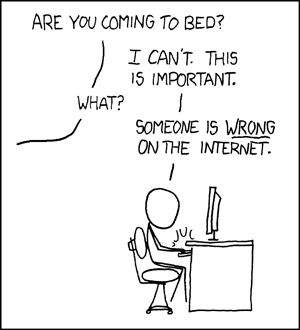
Mouse over the image for the full effect.
I emphatically recommend xkcd to anyone who hasn't found it, yet.
**So as not to clog the chaplain's serious post with any more of my silliness, I've moved this bit of wishful thinking over here.

Now before you say he is too conservative, he has other qualities that make him more of a moderate.

She brings some balance in being more tolerant of science and technology, though she is absolutely firm on the banning of compressed air and Roombas. She will relieve the apprehensions of the hawks in the party as she is very big on domestic espionage, pre-emptive strikes and, when absolutely warranted, "enhanced interrogation techniques." Big Business will also find a friend in Stella, especially the box, plastic bag and suitcase industries.
As a bonus, both candidates are DRM free!
If you think these are candidates you can get behind, I encourage you to join our massive write-in campaign and elect Jasper K. Purrface and Stella Bug Monkeybutt in 2008.
Don't.
Really, don't even bother. I've spent DAYS following and commenting on the saga of the "Atheists hate America" billboard in Pennsylvania. Over 90% of the comments are from atheists and freethinkers. It doesn't stop the idiots from making comments like:
And my favorite:
Apologetic billboard replaces atheistic sign 2-5
Battle of the Chambersburg billboards 2-9 - commented
Our view: Defensive billboard goes a bit overboard 2-10
Letter to the editor: Editorial puzzles billboard sponsor 2-12 - commented
'Imagine No Religion' billboard's source has different tale to tell 2-13 - commented
Billboards motivate far-flung reactions 2-14 - commented
Fuck it. I'm not even discussing it anymore. The minute someone even mentions support for creationism, intelligent design, young earth, Mike Huckabee or any of that Fundamentalist bullshit, I'm just going to reply,"Fuck you. You're an idiot. Stop infecting my fucking gene pool with your worthless, malformed gametes, you son of a pig-whore jackass." And then, I might even kick them skwa in the nuts.
Really.
I'm serious.
Okay, my bad idea to combat the American obesity epidemic is to make all the one-way streets also apply to pedestrians.
My bad idea to end the War in Iraq is to allow it to apply to be our 51st state.
My bad idea to combat global climate change is to have violent crime convicts on work furlough shave all the polar bears.
My bad idea to fix American health care is to have Canada forcefully annex the U.S. while our troops are overseas.
My bad idea to strengthen the economy is to implement an I.R.S. lottery in which everybody who pays a little more in taxes is entered to win the eternal right never to pay any more income tax at all.
My bad idea to solve illegal immigration is to spread cartoon pushpins over the Arizona desert.
...and my bad idea to have readers take me more seriously...write less seriously.
"The well-meaning contention that all ideas have equal merit seems to me little different from the disastrous contention that no ideas have any merit." - Carl Sagan


 Posts
All Comments
Posts
All Comments


